What are you reading?
Comments
-
I will eat anything that isn't poisonous (well., I ate some amanita muscarias back in the day -- slightly toxic). Is it really that bad?
1 -
Flavor is pretty rough and I’ve tasted worse things, but the texture is the killer. That along with the taste puts it way over the top.
If it don’t bother me, it don’t bother me. Just leave me alone.
1 -
-
nasty stuff:
Chlorine trifluoride has been investigated as a high-performance storable oxidizer in rocket propellant systems. Handling concerns, however, severely limit its use. The following passage by rocket scientist John D. Clark is widely quoted in descriptions of the substance's extremely hazardous nature:
It is, of course, extremely toxic, but that's the least of the problem. It is hypergolic with every known fuel, and so rapidly hypergolic that no ignition delay has ever been measured. It is also hypergolic with such things as cloth, wood, and test engineers, not to mention asbestos, sand, and water—with which it reacts explosively. It can be kept in some of the ordinary structural metals—steel, copper, aluminum, etc.—because of the formation of a thin film of insoluble metal fluoride that protects the bulk of the metal, just as the invisible coat of oxide on aluminium keeps it from burning up in the atmosphere. If, however, this coat is melted or scrubbed off, and has no chance to reform, the operator is confronted with the problem of coping with a metal-fluorine fire. For dealing with this situation, I have always recommended a good pair of running shoes.[18]
more here:
https://en.wikipedia.org/wiki/Chlorine_trifluoride3 -
Dogs can learn new words by overhearing
Some gifted dogs can learn words for hundreds of objects and pick up new ones just by listening in to the conversations of human family members — abilities that put them on a par with infants at about 18 months old. Only a few animals, including bonobos (Pan paniscus) and an African grey parrot (Psittacus erithacus), have been observed to recognize objects through unique names. Learning words indirectly through watching human interactions is even harder because it requires following a person’s gaze and, to some extent, understanding their intentions.NPR | 8 min read
https://www.npr.org/2026/01/08/nx-s1-5667604/genius-dogs-learn-new-words-eavesdropping
4 -
Join us on Zoom vHerf (Meeting # 2619860114 Password vHerf2020 )0
-
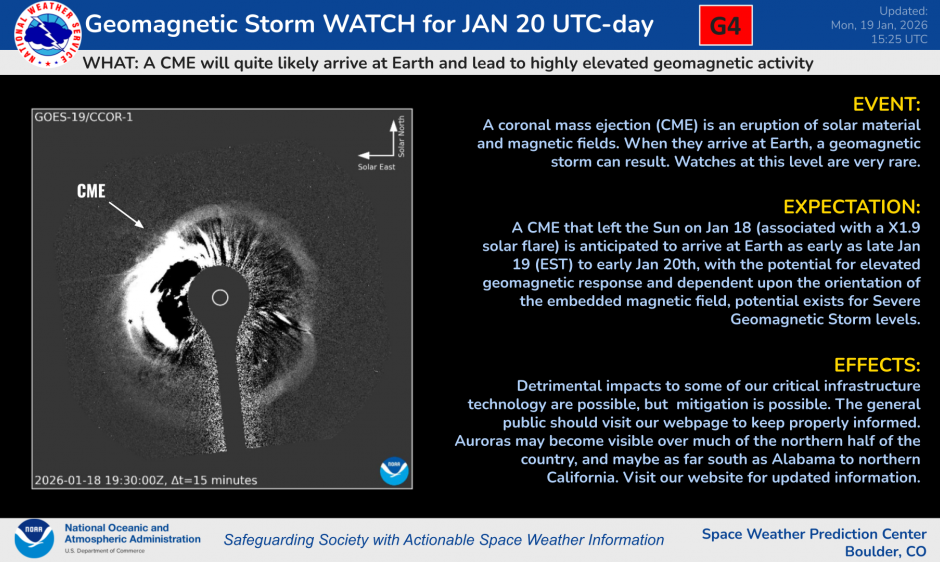
Geomagnetic storm
 2
2 -
 6
6 -
New Iberia Blues by one of my favorite authors, James Lee Burke. 2019
3 -
Brain signals cause heart-attack damage
Frenzied crosstalk between the heart, the brain and the immune system could be what damages the heart after a myocardial infarction, a study in mice suggests. Researchers found that during a heart attack, a set of neurons in the vagus nerve relay signals between the heart and the brain, which activates immune and inflammatory responses and causes widespread damage to the heart. Blocking these signals improved outcomes after heart attacks, which could pave the way for developing new therapies.and into the weeds here:
4 -
AI and privacy pitfalls:
"When information is all in the same repository, it is prone to crossing contexts in ways that are deeply undesirable. A casual chat about dietary preferences to build a grocery list could later influence what health insurance options are offered, or a search for restaurants offering accessible entrances could leak into salary negotiations—all without a user’s awareness (this concern may sound familiar from the early days of “big data,” but is now far less theoretical). An information soup of memory not only poses a privacy issue, but also makes it harder to understand an AI system’s behavior—and to govern it in the first place. So what can developers do to fix this problem?
0 -
They can kill it. That’s the only solution. They’ve opened Pandora’s box. Only one way to close it.
If it don’t bother me, it don’t bother me. Just leave me alone.
4 -
Abstract
In 2009 and again in 2019, public health warnings were confirmed by the emergence, rapid widespread transmission, and lethality of novel influenza and coronaviruses. The world continues to suffer disease from these respiratory viruses. Two newly recognized emergent respiratory viruses, influenza D and canine coronavirus HuPn-2018, have been shown to have considerable potential for causing future human epidemics, but diagnostics and surveillance for the viruses are lacking. We reviewed data regarding influenza D virus and coronavirus canine coronavirus HuPn-2018. Those data strongly indicate that these viruses are major newly recognized threats. However, little is being done to respond to or prevent disease associated with these viruses, warranting the question of whether we will learn from previous pandemics.1 -
Between being and emptiness
In Japanese philosophy, unlike the atomised Western self, we are ‘ningen’ (人間), each enmeshed with other humans and naturehttps://aeon.co/essays/the-japanese-ethics-of-ningen-dethrones-the-western-self
3 -
That's very thought-provoking, Edward... a different/new way to look at me/life/being. I don't see a conflict with my conception of self/others/nature. That said, I can't claim to understand a bunch of the article, but I still enjoyed the read. Thanks.
"I could've had a Mi Querida!" Nick Bardis1 -
@Yakster said:
Finished reading Brief cases : more stories from the Dresden files by Jim Butcher and picked this up from the library after returning the book I just finished.
One of my favorite authors.
1 -
Oh that's just great, wait 'till the cia gets this access to opponents' brains
0 -
Men who stare at goats
"If you do not read the newspapers you're uninformed. If you do read the newspapers, you're misinformed." -- Mark Twain0 -
Elephant trunk whiskers exhibit material intelligence, revealing the secret behind an amazing sense of touch
by Max Planck Society
...
"Schulz said, "It's pretty amazing! The stiffness gradient provides a map to allow elephants to detect where contact occurs along each whisker. This property helps them know how close or how far their trunk is from an object…all baked into the geometry, porosity, and stiffness of the whisker. Engineers call this natural phenomenon embodied intelligence." Excitingly, domestic cat whiskers show the same kind of stiffness gradient."This discovery excites Schulz and Kuchenbecker, who are working to apply these insights from nature to applications in robotics and intelligent systems. "Bio-inspired sensors that have an artificial elephant-like stiffness gradient could give precise information with little computational cost purely by intelligent material design," Schulz said."
https://phys.org/news/2026-02-elephant-trunk-whiskers-material-intelligence.html
2 -
Gravitational lensing technique unveils supermassive black hole pairs
https://phys.org/news/2026-02-gravitational-lensing-technique-unveils-supermassive.html
0 -
Scientists Capture the Clearest View Yet of a Star Collapsing Into a Black Hole
The star, in the Andromeda galaxy, collapsed and disappeared without first exploding in a supernova.https://news.columbia.edu/news/scientists-capture-clearest-view-yet-star-collapsing-black-hole
2 -
Wish they would have shown us the actual photos instead of ones generated by the IPAC lab.
If it don’t bother me, it don’t bother me. Just leave me alone.
1 -
Here's all you (probably) need to know about slugs having sex
How do slugs mate? A guide to slimy slug sex | Discover Wildlife https://share.google/nqNEheTXMumcw0fRE
1 -
@Rdp77 said:
Wish they would have shown us the actual photos instead of ones generated by the IPAC lab.here is the article source for the pictures:
https://www.science.org/doi/10.1126/science.adt4853 1
1 -
@silvermouse said:
@Rdp77 said:
Wish they would have shown us the actual photos instead of ones generated by the IPAC lab.here is the article source for the pictures:
https://www.science.org/doi/10.1126/science.adt4853Thanks Edward
If it don’t bother me, it don’t bother me. Just leave me alone.
1